
When selecting a reinforcement layer for an interventional catheter or delivery system, engineers usually find themselves choosing between a braid and a helical coil. While braids dominate applications requiring high torque and pushability, coil reinforcement is the gold standard when the clinical path demands extreme flexibility, crush resistance, and a 100% open lumen under stress.
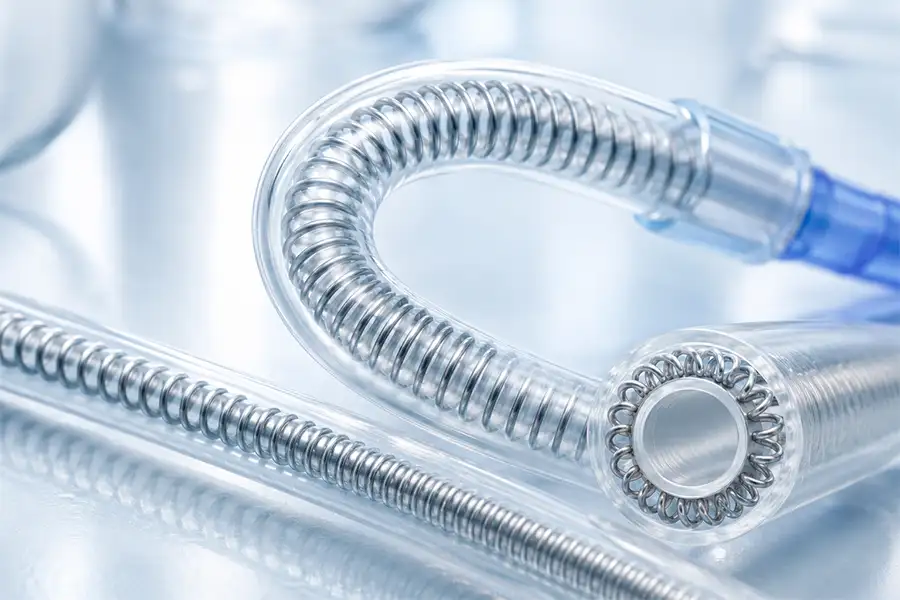
Understanding exactly why and when to specify a coil rather than a braid can prevent costly re-designs late in your product development cycle.
The Mechanics of Coil Reinforcement
Coil reinforcement involves wrapping a single wire or multiple wires (filars) helically around a thin inner liner (typically PTFE) before encapsulating the assembly with an outer polymer jacket. Because the wire continuously spirals in one direction without interlocking or crossing over itself, it acts like a micro-engineered spring built directly into the catheter wall.
3 Critical Reasons to Choose Coil Reinforcement
1. Unmatched Kink Resistance in Tortuous Paths
When an unreinforced or braided catheter is forced around a sharp anatomical bend—such as the aortic arch, renal arteries, or intracranial siphons—the circular cross-section tends to flatten out (ovalization). If the bend is sharp enough, the wall collapses, causing a catastrophic kink.
- The Coil Advantage: The individual turns of a helical coil act as rigid support rings. When the catheter bends, the coil segments distribute the stress evenly along the longitudinal axis, forcing the inner lumen to maintain its perfect roundness even under acute 180-degree deflections.
2. Superior Radial and Crush Strength
Devices that must withstand heavy external pressure from surrounding anatomy, or intense internal pressure from fluid delivery, require high radial strength.
- The Coil Advantage: Coils provide continuous hoop stress reinforcement. This prevents the catheter from compressing radially when clamped or tightly squeezed, and prevents the liner from compressing inward when large-profile devices are passed through the inner diameter (ID).
3. True Structural Flexibility
Because a coil has no interlocking cross-wires to restrict lateral movement, it allows the catheter shaft to remain highly compliant. The shaft can flex naturally with the movement of the vessel or endoscope without imparting a rigid, straightening force that could cause vessel trauma.
Coil reinforcement utilizes a single or multi-filar wire wound helically around the inner liner, resembling a continuous spring.
Ideal Clinical Applications for Coiled Shafts
Coil reinforcement is typically specified for devices acting as flexible conduits or high-vacuum extraction tools:
- Thrombectomy Aspiration Catheters: Where the shaft must resist collapsing inward when high negative vacuum pressure is applied to pull out blood clots.
- Endoscopic and GI Delivery Systems: Where the catheter must travel down the tight, highly tortuous working channel of a flexible endoscope without binding.
- Balloon Catheter Shafts (Under Balloon Area): Coils are frequently placed beneath the inflation balloon to prevent the main guide wire lumen from collapsing when the balloon is fully pressurized.
Engineering Considerations: Filar Count and Pitch
When specifying a coil, your manufacturing partner will help you tune two critical variables:
- Pitch (Spacing): A tight pitch (close spacing between coils) maximizes kink and crush resistance but increases shaft stiffness. A loose pitch increases flexibility but reduces radial support.
- Filar Count: Utilizing multi-filar coiling (parallel wires wound simultaneously) allows for thinner wire profiles while maintaining identical mechanical support, helping minimize the catheter’s overall wall thickness.
Design Your Coil Architecture
Are you engineering a device that needs to navigate tight turns without losing lumen integrity? Our engineering team utilizes advanced, programmable coiling machinery to wind precise single- and multi-filar configurations over ultra-thin liners. Contact us today to discuss your mechanical performance targets.