
When you’re specifying tubing for a new catheter or delivery system, one of the earliest and most consequential decisions is lumen configuration. Should your design use a single-lumen extrusion, or does it need two, three, or more lumens running through the same shaft? The answer shapes everything downstream—material selection, wall thickness tolerances, braid or coil reinforcement options, and even how the device will be assembled and tested.
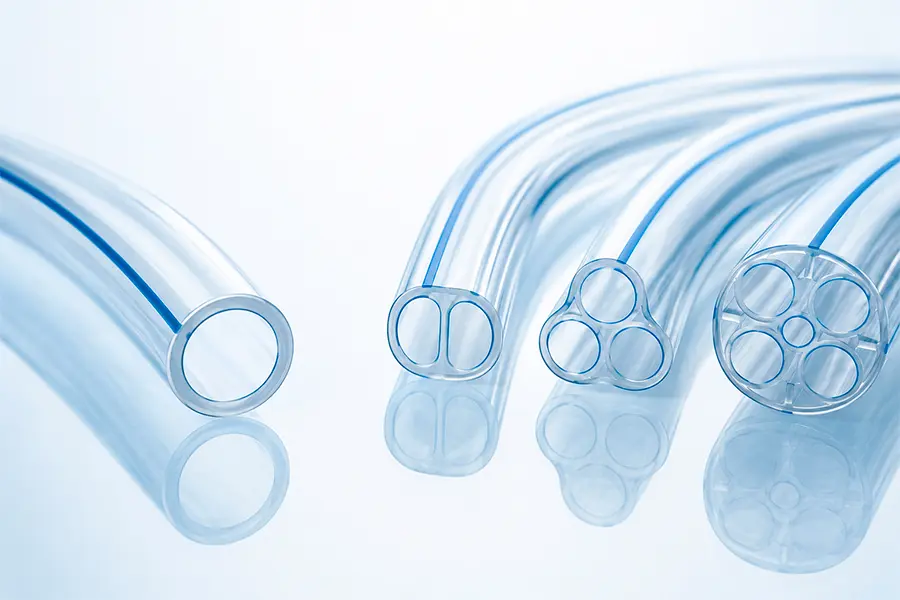
What Single-Lumen Extrusion Offers
A single-lumen tube has one continuous channel running through its length. It’s the simplest extrusion geometry to manufacture, which typically translates into:
- Tighter, more consistent tolerances—fewer features means less that can shift during extrusion
- Lower cost and shorter lead times—simpler tooling and setup
- Higher achievable flexibility for a given outer diameter, since wall thickness can be optimized without needing to preserve multiple internal channels
Single-lumen designs are the right call when your device only needs to deliver one function through the shaft—for example, a simple guide catheter, a basic infusion tube, or an over-the-wire delivery system where the wire and any secondary function share the same channel sequentially rather than simultaneously.
What Multi-Lumen Extrusion Offers
Multi-lumen tubing packs two or more discrete channels into a single extruded profile—often within a shaft no larger than a single-lumen equivalent. This is where extrusion engineering gets genuinely complex, because each lumen has to maintain its own dimensional integrity while sharing wall material with its neighbors.
Multi-lumen constructions are typically specified when a device needs to perform more than one function at the same time through the same shaft, such as:
- Simultaneous guidewire access and fluid/contrast delivery
- Separate inflation and deflation channels for balloon catheters
- Independent sensor, pull-wire, or steering mechanism channels alongside a main working lumen
- Segregating fluids or materials that can’t share a single channel
The tradeoff is manufacturing complexity. Multi-lumen extrusion requires more sophisticated tooling, tighter process control to prevent lumen migration or wall thinning, and generally carries tighter cost and lead-time implications than single-lumen tubing.
Quick Comparison
| Feature | Single-Lumen | Multi-Lumen |
| Tooling Complexity | Low | High |
| Tolerance Control | Easier to maintain | Highly challenging |
| Functional Capability | Sequential or single-use | Simultaneous multi-use |
| Downstream Assembly | Straightforward | Complex (requires skiving/tipping) |
Key Factors That Drive the Decision
1. Functional requirements. Start with what the device actually needs to do simultaneously, not sequentially. If two functions never operate at the same time, they may be able to share a single lumen with a switching mechanism, avoiding multi-lumen complexity altogether.
2. Outer diameter constraints. Minimally invasive applications often have an aggressive OD target. Multi-lumen designs must fit every channel, wall, and reinforcement layer within that envelope—which can force tradeoffs in individual lumen size or wall thickness.
3. Pushability and torque response. Adding lumens changes how the shaft behaves mechanically. Asymmetric lumen placement, in particular, can affect column strength and torque transmission, so lumen geometry needs to be considered alongside—not separately from—reinforcement strategy (braid or coil).
4. Tolerance requirements. Multi-lumen tubing requires each individual lumen to hold its own dimensional tolerance while the overall profile holds its OD tolerance. This is a materially harder manufacturing problem than a single concentric lumen, and it’s worth discussing early with your extrusion partner rather than assuming any tolerance is achievable by default.
5. Downstream assembly. How will each lumen be accessed at the proximal and distal ends? Multi-lumen shafts often require more complex tipping, skiving, or bonding operations to separate and terminate individual lumens—factor this into your overall process plan, not just the extrusion step.
Getting It Right Early
Lumen configuration isn’t a detail to finalize late in development—it interacts with material choice, reinforcement strategy, and OD targets from the earliest stages of design. The most efficient path is usually to bring your functional requirements and OD constraints to your extrusion partner before finalizing the design, so tolerances, feasibility, and cost can be assessed together rather than discovered during tooling.
Whether your project calls for a straightforward single-lumen shaft or a complex multi-lumen construction with tight-tolerance individual channels, having an extrusion partner who can validate feasibility early—and iterate on tooling before you’re locked into a design—will save significant time and rework later in your development cycle.
Have a catheter design in progress and need help evaluating lumen configuration? Contact our engineering team to discuss your application’s specific requirements.