
Many catheter and delivery system designs need more than a single, uniform material running through the tube wall. Whether it’s a radiopaque marker line for fluoroscopic visibility or a colored stripe for orientation and identification, these features are typically built directly into the tube wall through co-extrusion—producing multiple materials simultaneously, as one integrated part, rather than adding them as a secondary step after the base tube is made.
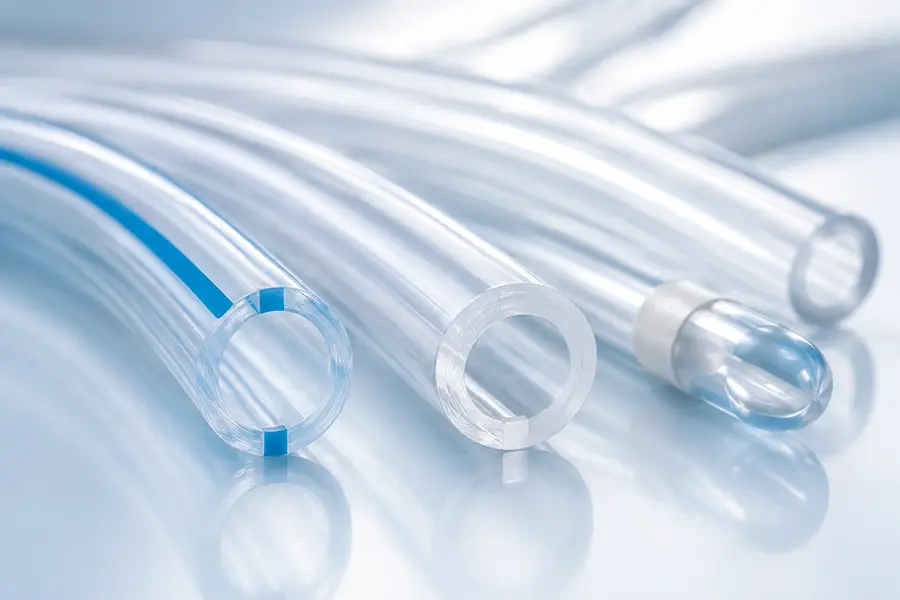
What Co-Extrusion Actually Means
Co-extrusion feeds two or more materials through separate extruders into a shared die, where they merge into a single tube wall in one continuous process. The materials stay distinct—for example, a radiopaque compound sits alongside or within the base polymer—while bonding together as they cool, rather than blending into a single homogeneous material.
This is different from adding a marker band or stripe after extrusion (such as heat-shrinking a radiopaque band onto a finished tube). Co-extrusion builds the feature into the wall itself during manufacturing, which generally offers:
- No secondary bonding step or bond-line failure risk
- Consistent placement and dimension of the radiopaque or striped feature along the full length
- A smoother outer profile, since the added material doesn’t sit as a separate layer or raised feature
- Better long-term durability, since the materials are integrated rather than mechanically or adhesively attached
Radiopaque Tubing
Radiopaque features let a device be visualized under fluoroscopy during a procedure — critical for confirming catheter position and tip location in real time. Radiopaque co-extrusion typically works by incorporating a filler material (commonly barium sulfate, bismuth compounds, or tungsten) into a defined stripe, band, or full-wall section of the tube, giving that region sufficient radiographic density to appear clearly on imaging while the rest of the tube remains standard material.
Common configurations include:
- A single radiopaque stripe running the length of the tube, often used for tip location or orientation
- A radiopaque band or segment localized to the distal tip, where visualization matters most
- Full-wall radiopaque sections, used when maximum fluoroscopic visibility is required over a longer segment
Design considerations include filler loading level (which affects both radiopacity and the base material’s mechanical properties), placement precision, and ensuring the radiopaque segment doesn’t compromise flexibility or bonding at that location.
Striped Tubing
Striped tubing serves a different purpose—usually visual identification and orientation rather than imaging. A colored stripe running the length of a tube can help clinicians track catheter rotation during a procedure, or help distinguish between multiple similar-looking components in multi-catheter procedures.
Striping is typically achieved by co-extruding a small volume of pigmented material into a stripe running along the tube’s length, using the same simultaneous-extrusion approach as radiopaque tubing, just with a colorant rather than a radiopaque filler.
Key Manufacturing Considerations
Material compatibility. The stripe or radiopaque material needs to bond reliably with the base polymer through the co-extrusion process—not every filled or pigmented compound is fully compatible with every base resin, so this needs validation, not assumption.
Stripe/band placement and consistency. Whether it’s a full-length stripe or a localized marker band, position and dimensional consistency need to be held within tolerance along the entire production length—meaningful for both function (a marker band needs to be where the design says it is) and appearance.
Effect on mechanical properties. Radiopaque fillers, in particular, can change the stiffness and flexibility of the section they’re in compared to the base material. This needs to be accounted for in the overall shaft design, not treated as a cosmetic addition.
Process control. Co-extrusion adds complexity to an already precise process—multiple material streams need to merge consistently at the die, which requires tight process control and in-line monitoring to catch drift before it results in an out-of-spec production run.
Bringing It Into Your Design Early
Radiopaque and striped features are easiest to build in—and validate—when they’re part of the original tubing specification rather than an afterthought. If your design needs fluoroscopic visibility at a specific location, or orientation marking along the shaft, raising it with your extrusion partner during initial specification lets material compatibility, placement, and mechanical impact all be assessed together, rather than discovered during scale-up.
Need a radiopaque marker or striping feature built into your tubing? Consult our engineering team.