
Material selection is one of the highest-impact decisions in catheter shaft design. It determines flexibility, torque response, kink resistance, chemical compatibility, and ultimately whether the finished device can navigate the intended anatomy safely and reliably. Three materials come up constantly in these conversations—PEBA, nylon (polyamide), and PEEK—each with a distinct performance profile and best-fit use case.
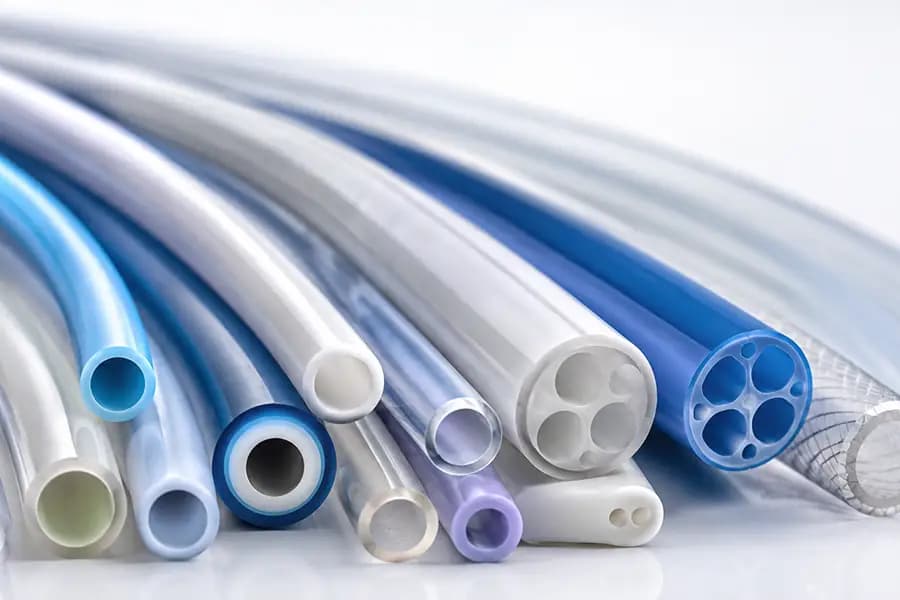
PEBA (Polyether Block Amide)
PEBA is a thermoplastic elastomer widely used in catheter shafts because it offers a rare combination: it can be formulated across a wide hardness range (from soft, highly flexible grades to stiffer, more torque-transmitting grades) while retaining excellent flexibility and kink resistance at any given durometer.
Strengths:
- Available across a broad durometer range, making it a common choice for multi-durometer shafts that transition from stiff proximal sections to flexible distal tips
- Excellent flexibility-to-strength ratio—flexes without kinking
- Good chemical resistance and biocompatibility profile for typical catheter applications
- Can be co-extruded or thermally bonded in transition zones between different durometers
Typical applications: Steerable catheter shafts, distal tip sections, multi-durometer shafts requiring smooth stiffness transitions along their length.
Tradeoffs: Generally, more expensive than nylon, and while durable, it doesn’t match PEEK’s performance in high-temperature or highly abrasive environments.
Nylon (Polyamide, e.g., Nylon 12, Nylon 11)
Nylon has been a workhorse catheter material for decades because it strikes a reliable balance between cost, processability, and mechanical performance.
Strengths:
- Strong stiffness-to-wall-thickness ratio, useful where pushability matters
- Good chemical resistance and dimensional stability
- More economical than PEBA or PEEK, especially at scale
- Well understood processing characteristics, supporting tight tolerances and reliable co-extrusion with other materials
Typical applications: Guide catheter shafts, introducer sheaths, and applications where higher stiffness and pushability are prioritized over maximum flexibility.
Tradeoffs: Nylon is generally less flexible than PEBA at a comparable wall thickness, and it doesn’t offer the same broad durometer range for smooth stiffness transitions.
PEEK (Polyether Ether Ketone)
PEEK is a high-performance thermoplastic used where mechanical and thermal demands exceed what standard catheter polymers can support.
Strengths:
- Exceptional strength and stiffness, even in very thin walls—useful for minimizing profile without sacrificing column strength
- Outstanding chemical resistance and thermal stability
- High abrasion resistance, relevant for devices navigating tortuous or calcified anatomy
- Can enable very thin-wall constructions that still resist kinking and crushing
Typical applications: High-pressure applications, thin-wall/small-profile shafts requiring high strength, applications with demanding thermal or chemical exposure requirements, and reinforcing liners under braid or coil layers.
Tradeoffs: PEEK is significantly more expensive than nylon or PEBA, generally less flexible, and requires tighter process control due to its higher processing temperatures—not every extrusion partner has the equipment and expertise to hold tolerance with it reliably.
How to Approach the Decision
Material selection shouldn’t be made in isolation from the rest of the shaft design. A few questions to work through with your extrusion partner:
- What’s the flexibility gradient along the shaft? Many catheters use two or three materials in sequence—e.g., a stiffer nylon or PEEK proximal section transitioning to a softer PEBA distal tip—rather than one material for the entire length.
- What are the anatomical and procedural demands? Tortuosity, required pushability, and exposure to bodily fluids or sterilants all influence the right material family.
- What’s the target wall thickness and OD? Thinner walls generally favor higher-strength materials like PEEK to maintain column strength and kink resistance.
- What’s the cost and volume profile of the program? PEEK’s performance comes at a real cost premium; it should be reserved for sections of the shaft that actually require it, not applied as a blanket material choice.
A Note on Co-Extrusion and Transitions
Many production catheter shafts don’t use a single material end-to-end—they combine materials in a single co-extrusion or use thermal bonding to join distinct sections with different durometers or polymer families. Getting these transitions right (avoiding stress risers, maintaining consistent OD/ID, and ensuring reliable bond strength) is as much a manufacturing capability question as a materials question, so it’s worth discussing early with whoever will be producing your tubing.
Not sure which material—or combination of materials—fits your application? Talk to our team about your shaft’s mechanical and procedural requirements.