
Navigating the intracranial vasculature introduces some of the most unforgiving design constraints in the medical device industry. To reach target vessels in the brain—such as the M1 or M2 segments of the middle cerebral artery—a neurovascular catheter must safely traverse the acute, 180-degree loops of the internal carotid artery (the carotid siphon).
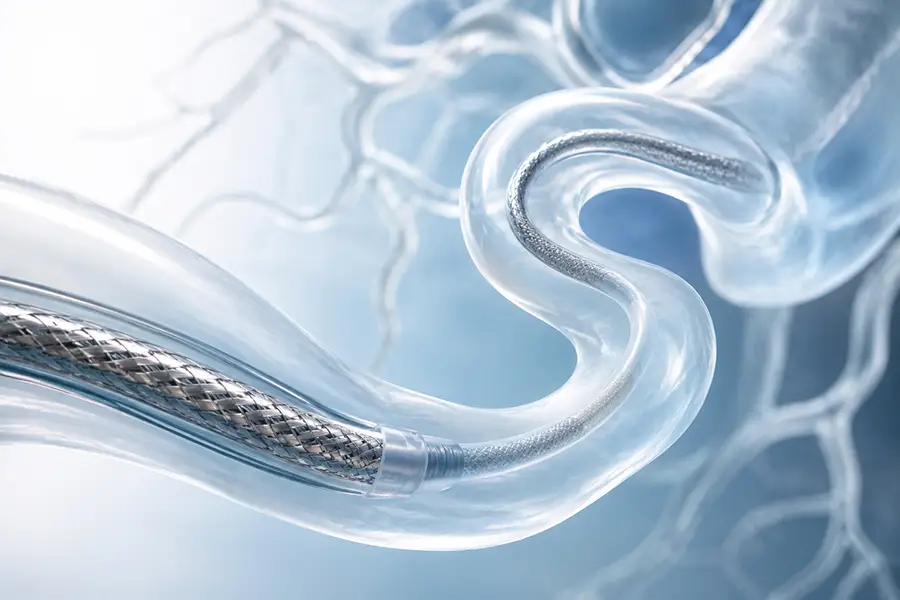
For ischemic stroke thrombectomy, aneurysm coil deployment, or intracranial stenting, the catheter shaft must be incredibly low-profile, highly kink-resistant, and capable of transmitting crisp tactile feedback. Meeting these demands requires specialized micro-braiding engineering.
Critical Design Challenges in the Neurovascular Space
Designing a braided shaft for neurovascular access requires solving three competing engineering challenges simultaneously:
1. Aggressive Profile Minimization (Wall Thickness Reduction)
Intracranial access routes demand ultra-small outer diameters (often 3 Fr or lower for microcatheters), yet clinicians require the largest possible internal diameter (ID) to maximize aspiration flow rates or accommodate secondary therapeutic devices.
- The Engineering Solution: Standard round wire braiding adds too much wall thickness. Neurovascular shafts utilize ultra-thin flat wire (e.g., 0.0005″ x 0.002″ stainless steel or Nitinol) to minimize total wall profile while maintaining robust structural reinforcement.
2. Extreme Kink Resistance Under High Vacuum
In mechanical thrombectomy, large-bore aspiration catheters apply high negative pressure directly to a clot. If the shaft kinks or collapses radially under vacuum while sitting in a sharp bend, the procedure fails.
- The Engineering Solution: Implementing a high-density, variable-pitch braid at the distal tip. Increasing the PPI (Pics Per Inch) at the distal end ensures that the cross-sectional roundness of the lumen is preserved even under tight deflection and negative pressure.
3. Non-Traumatic Distal Transitions
A sudden transition from a stiff proximal shaft to a soft distal tip creates a structural weak spot prone to buckling or causing vessel trauma.
- The Engineering Solution: Utilizing a multi-segmented polymer jacket reflow over a continuous braid. By seamlessly transitioning the outer encapsulation jacket from a rigid durometer (e.g., 72D Pebax®) proximally to an ultra-soft durometer (e.g., 25D or 35D Pebax®) distally, the catheter tracks smoothly without kink points.
Material Selections for Neurovascular Braids
- 304V Stainless Steel Flat Wire: The industry standard for maximizing column strength, torque transmission, and pushability through the femoral or radial access sites.
- Nitinol (NiTi) Wire: Increasingly specified for distal segments where superelasticity is required. Nitinol braids can undergo extreme deformation without taking a permanent kink set, ensuring repeated tracking reliability.
- PTFE Liners: Essential for the inner diameter to ensure that secondary microcatheters, guide wires, or clot-retrieval stents glide through the lumen with zero resistance.
Designing for Compliance and Safety
Beyond mechanical performance, neurovascular shafts must be engineered to minimize particulate generation—a critical metric for neurovascular regulatory approval. Proper encapsulation of the braid layer via uniform thermal reflow is paramount to ensure that no wire ends or loops can delaminate or breach the polymer outer skin during intense clinical manipulation.
Partner with a Micro-Braiding Expert
At One Medical Extrusion we specialized in pushing the limits of catheter thin-wall architectures. From custom flat-wire micro-braiding to multi-zone variable-pitch optimization, our engineering team helps OEM innovators bring next-generation neurovascular devices to market faster.
Contact us today to discuss your target profile dimensions and mechanical requirements.