
Tolerance is where catheter design meets manufacturing reality. A drawing can specify any dimension an engineer wants, but what actually gets produced—consistently, at scale, and within a validated process—depends on what’s achievable with a given material, geometry, and extrusion process. Knowing what to specify, and why, helps OEMs avoid both over-specifying (which drives up cost and scrap rates) and under-specifying (which risks device performance or reliability issues downstream).
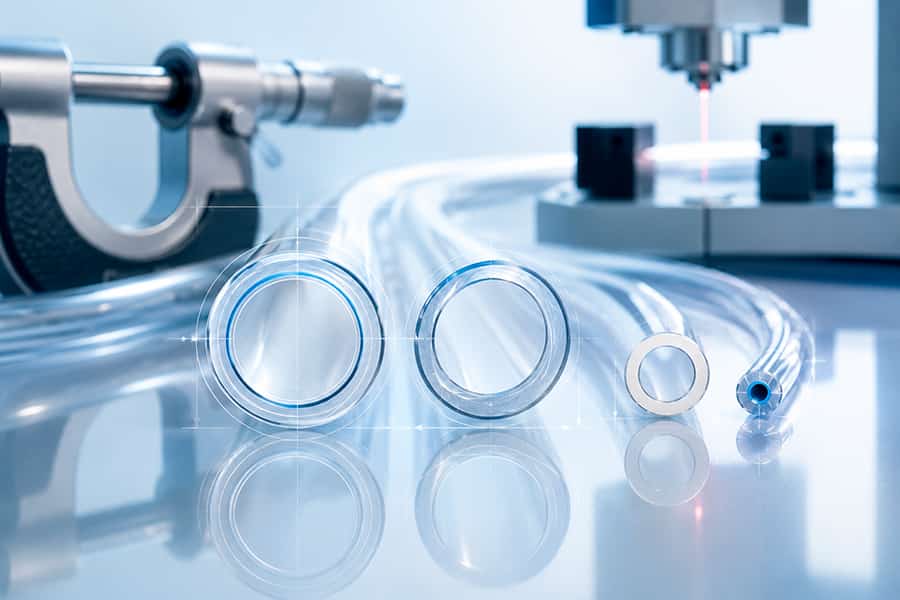
The Core Dimensions That Need Tolerance Specification
Outer diameter (OD). Usually the most visible spec, since OD often has to fit within a delivery system, guide catheter, or introducer sheath. OD tolerance directly affects fit and compatibility with other components.
Inner diameter (ID). Critical for anything that needs to pass through the lumen—a guidewire, a stylet, contrast media, or another device. ID tolerance also drives wall thickness consistency when OD is fixed.
Wall thickness (and concentricity). Wall thickness affects burst strength, flexibility, and kink resistance. Concentricity—how evenly the wall thickness is distributed around the circumference—matters just as much as the average thickness, since an eccentric wall can create a weak point even if the average thickness meets spec.
Lumen-to-lumen dimensions (multi-lumen only). Each lumen needs its own ID/OD and wall tolerance, plus a specification for lumen placement relative to the others and to the overall OD.
Why Tolerances Aren’t Free
It’s tempting to specify the tightest tolerance possible “to be safe,” but tighter tolerances carry real tradeoffs:
- Cost. Tighter tolerances typically require slower line speeds, more frequent in-line measurement and adjustment, and higher scrap rates—all of which affect unit cost.
- Material and geometry limits. Some combinations of material, wall thickness, and diameter have a practical tolerance floor. A tolerance that’s easily achievable on a thick-wall, large-diameter nylon tube may not be realistic on a thin-wall, small-diameter PEEK multi-lumen tube.
- Process capability, not just target. A tolerance spec should reflect what a process can hold consistently over a full production run (its process capability), not just what’s achievable on a best-case sample.
Questions to Work Through With Your Extrusion Partner
1. What does the tolerance actually need to protect? Is it fit with a mating component, lumen patency, wall integrity for burst pressure, or something else? Tying each tolerance to its functional purpose helps avoid over-specifying dimensions that don’t materially affect performance.
2. What’s the real process capability, not just the equipment spec? Ask for data on how a given tolerance has performed historically on similar material/geometry combinations—not just what’s theoretically possible on a single sample part.
3. How will tolerance be measured and enforced in production? In-line laser micrometry, statistical process control, and defined sampling plans all affect how reliably a tolerance is actually held across a production lot, not just at first article inspection.
4. Are your tolerances consistent with your regulatory and testing strategy? Tolerances feed directly into design verification and validation testing. A tolerance that’s tighter than necessary can complicate testing and documentation without adding functional benefit; one that’s looser than necessary can create failures during V&V that require a redesign.
A Practical Approach
The most efficient path is usually to specify function first, tolerance second: define what each dimension needs to accomplish, then work with your extrusion partner to determine the tightest tolerance that’s both necessary and reliably manufacturable—ideally validated with early sample runs rather than finalized on paper alone. Bringing tolerance discussions into the conversation during early design, rather than after tooling is built, gives everyone room to adjust geometry or material choice if a spec turns out to be unnecessarily difficult to hold.
Need help evaluating what tolerances are realistic for your tubing design? Connect with our engineering team—we’re glad to review specs and process capability together