
When manufacturing high-performance reinforced catheter shafts, the structural integrity of the inner diameter (ID) during the braiding process is paramount. To prevent thin-walled liners—such as ultra-thin PTFE—from collapsing under the immense mechanical tension of a braiding machine, engineers traditionally rely on a sacrificial core mandrel running through the center of the assembly.
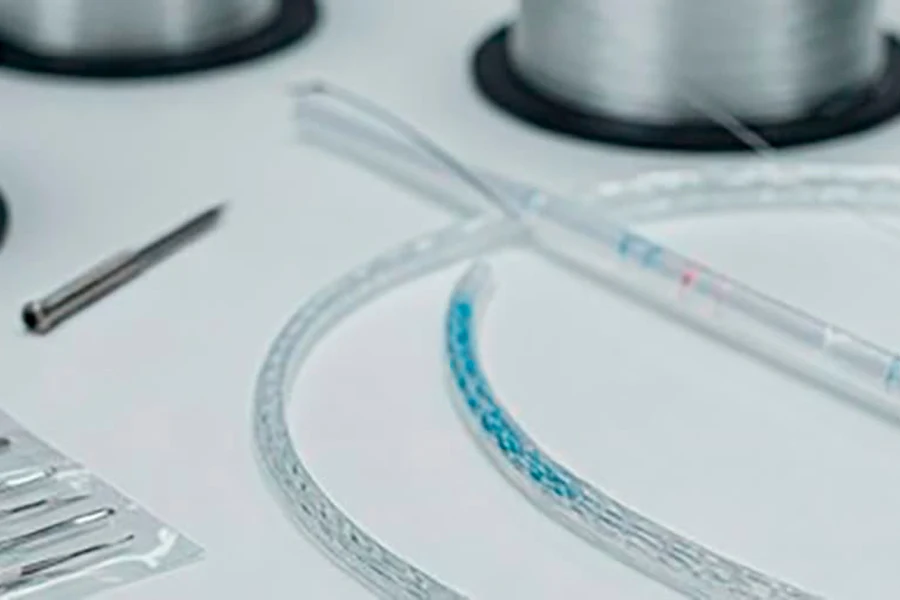
Historically, plated copper core wires have been the default industry standard for this sacrificial foundation. However, as catheter profiles shrink and regulatory standards around particulate contamination tighten, traditional copper mandrels introduce substantial manufacturing risks and supply chain volatility.
ELASOME™ is a proprietary, stretchable core technology engineered specifically to replace traditional copper-based cores, delivering a completely clean, more cost-effective manufacturing alternative.
The Core Vulnerability: Why Plated Copper Fails Modern DFM
Silver- or tin-plated copper wire has long been specified because it offers reliable tensile support during weaving and can be chemically dissolved or mechanically pulled to elongate and remove it post-reflow. Despite this, it introduces two major issues into the cleanroom:
1. Severe Particulate and Flaking Risks
During high-speed braiding, the metal wires from the bobbins repeatedly cross and rub against the core mandrel. This intense friction causes silver or tin plating on a copper core to scratch, fracture, and flake. These microscopic metal flakes can become permanently embedded in the catheter’s thin polymer jacket during the subsequent thermal reflow process, leading to rejected lots or catastrophic field failures due to particulate contamination.
2. Heavy Supply Chain and Processing Costs
Copper is highly vulnerable to global commodity price swings. Furthermore, sourcing high-tolerance plated core wire requires long lead times, ballooning the upfront cost of prototyping. Post-processing also demands expensive, highly regulated chemical or mechanical extraction steps to pull the elongated copper out without tearing the delicate PTFE liner.
The ELASOME™ Innovation: Contamination-Free Support
ELASOME™ approaches the reinforcement puzzle from a fundamentally different material standpoint. Instead of a rigid, plated metallic core that risks fracturing under friction, ELASOME™ utilizes a proprietary, high-elasticity composite material optimized explicitly for medical device braiding machinery.
[Traditional Method] Copper Core Wire ──> Bobbin Friction ──> Flaking/Particulates (High Scrap)
[ELASOME™ Method] Stretchable Core ──> Zero Flaking ──> Pristine Core ID (Cleanroom Safe)
Key Advantages of the ELASOME™ Matrix:
- Zero Contamination Profile: Because ELASOME™ features an unplated, highly unified elastomeric composition, there is no surface skin to flake, peel, or delaminate under the mechanical wear of braiding bobbins. Your cleanroom stays completely free of metallic particulate dust.
- Uniform Elastic Recovery: The material is explicitly engineered to withstand the axial compression and high radial hoop stress of tight-pitch diamond braids (high PPI) without changing its outer diameter profile.
- Effortless Post-Reflow Extraction: When the catheter shaft encapsulation is complete, ELASOME™ can be cleanly stretched longitudinally. Its unique elongation-to-break profile allows it to neck down evenly across the entire length of the shaft, pulling free from the ultra-thin PTFE liner with minimal friction and zero risk of tearing the lumen wall.
Side-by-Side Evaluation: Engineering Metrics
| Performance Metric | Traditional Plated Copper Cores | Proprietary ELASOME™ Cores |
| Material Composition | Plated Metal (Silver/Tin over Copper) | Specialized Elastic Composite Matrix |
| Contamination Risk | High (Prone to surface flaking under friction) | Zero (Homogeneous, unplated structure) |
| Supply Chain Lead Times | Lengthy, volatile commodity pricing | Shortened, predictable, and highly scalable |
| Extraction Dynamics | Prone to binding; requires heavy mechanical force | Uniform neck-down via controlled elongation |
| Application Versatility | Rigid; limited to standard spooling configurations | Adapts seamlessly to single-end mandrels or reel-to-reel setups |
Production Versatility: Matching Your Workflow
Transitioning away from copper cores should not mean upgrading your capital equipment. ELASOME™ was developed to adapt directly into your existing manufacturing infrastructure:
- Reel-to-Reel Processing: Available in continuous, precision-wound lengths on standard industrial reels for high-volume automated manufacturing lines.
- Single-End Discrete Mandrels: Can be cut and deployed as discrete localized mandrels for specialized, low-volume development projects or complex segmented catheter tips.
DFM Takeaway: Protect Your Yields Early
For sourcing managers and R&D engineers, material selection at the core level has a massive downstream impact on manufacturing yields. Relying on plated copper wire introduces an invisible cost tax in the form of particulate-related scrap rates. Transitioning to ELASOME™ simplifies your bill of materials (BOM), stabilizes your manufacturing costs, and fundamentally ensures a pristine, clinical-grade internal diameter.
Upgrade Your Braiding Process to ELASOME™
Ready to eliminate the limitations of copper-based cores and experience a cleaner, faster, more cost-effective production run? Contact our engineering team today to review your line dimensions, request ELASOME™ material specifications, or secure custom samples for your next manufacturing lot.