
An interventional catheter is a complex assembly of disparate materials. A high-performance shaft frequently features a lubricious PTFE liner, a metallic reinforcement braid or coil, a multi-segmented outer polymer jacket, and a rigid proximal hub.
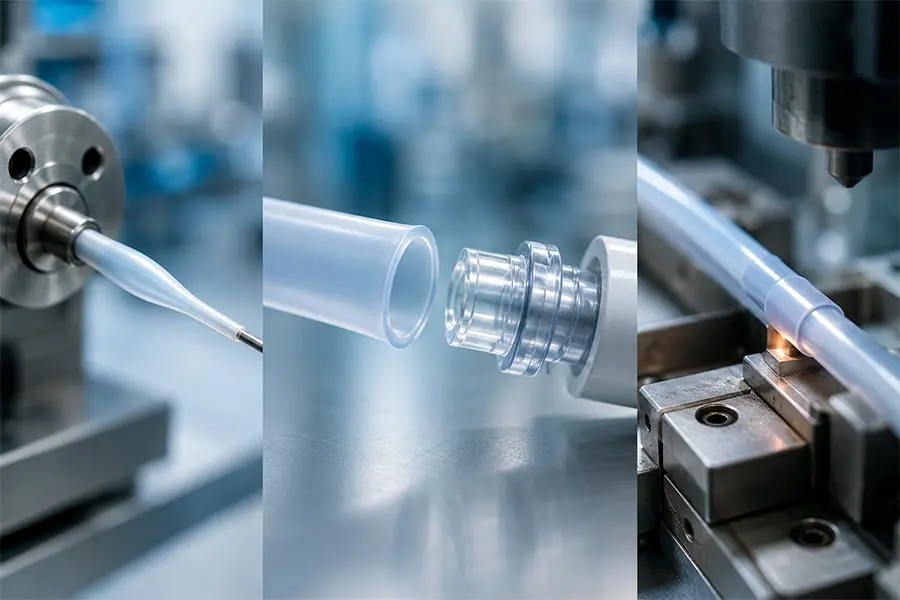
Connecting these distinct components into a smooth, seamless, and structurally sound medical device requires three foundational thermal manufacturing processes: tipping, flaring, and bonding. Optimizing these steps during the Design for Manufacturability (DFM) phase is critical to ensure trackability and prevent catastrophic field failures.
1. Precision Tipping: Designing Non-Traumatic Distal Ends
Catheter tipping is the process of molding the distal tip of the shaft into a specific geometric profile. This is typically achieved using RF (Radio Frequency) die forming. The catheter end is placed over a mandrel, inserted into a custom-shaped geometric die, and subjected to localized electromagnetic heating.
- Why It Matters: A well-designed tip ensures the catheter can cross tight lesions or enter delicate vessels without digging into or dissecting the vessel wall.
- Common Configurations:
- Tapered/Chamfered Tips: Smooth transitions for over-the-wire tracking.
- Blunt Tips: Ideal for maximum aspiration or fluid delivery surface area.
- Radiopaque Filled Tips: Fusing a short segment of polymer highly concentrated with tungsten or barium sulfate directly to the tip for clear visualization under fluoroscopy.
2. Flaring and Expanding: Preparing for Proximal Integration
Flaring involves widening the diameter of a tube’s end, while expanding involves stretching a localized segment of the tubing to a larger internal/external diameter.
- The Assembly Value: Flaring is primarily utilized to prepare a catheter shaft for hub bonding. By expanding the proximal end of the jacket, the shaft can securely slide over the rigid barbed connector of an injection hub or luer fitting, maximizing the mechanical surface area for subsequent thermal or adhesive bonding.
- Process Control: Precision control over the heating profile is vital here. Overheating the material during a flare operation can degrade the polymer chain, leading to micro-cracking and a compromised joint that could fail under high-pressure fluid injection.
3. Thermal and Adhesive Bonding: Fusing Disparate Layers
Once the components are tipped and flared, they must be permanently joined. Catheter manufacturing relies on two primary bonding methods:
Thermal Reflow Bonding (Fusing)
Thermal bonding utilizes localized heat and shrink tubing (such as FEP) to melt and compress overlapping polymer segments together. As the heat is applied, the polymers melt, flow into one another, and solidify into a single, seamless, continuous joint.
- Best For: Joining multi-durometer jacket segments along the shaft or fusing a soft tip to a stiffer braided shaft. This creates a transition zone with zero ridges or edges to catch on anatomy.
Adhesive Bonding
When joining polymers that are thermally incompatible (e.g., trying to bond a Pebax® shaft to a polycarbonate or metal hub), engineers utilize medical-grade UV-curable cyanoacrylates or light-curable epoxies.
- Best For: Proximal hub assembly and marker band encapsulation. Adhesive bonds require careful surface preparation, such as plasma or corona treatment, to ensure robust cross-linking with low-surface-energy plastics.
Engineering Best Practices for Seamless Assembly
| Manufacturing Goal | Recommended Process Approach | DFM Checkpoint |
| Eliminate Catch Points | Specify RF thermal reflow for tip-to-shaft transitions | Ensure overlapping materials have compatible melt temperatures |
| Maximize Hub Pull-Force | Utilize proximal flaring combined with a mechanical barb design | Validate surface energy treatment if using UV adhesives |
| Prevent Inner Lumen Collapse | Always use precision-ground interior mandrels during thermal forming | Match mandrel OD precisely to the internal diameter (ID) of your PTFE liner |
Streamline Your Assembly Workflow
Designing a high-performance catheter means designing a reliable assembly workflow. Our engineering team provides end-to-end support, matching our precision extrusion and coiling capabilities with state-of-the-art RF tipping, flaring, and bonding operations. Contact us today to optimize your catheter assembly process.