
In catheter design, braiding is rarely a “one-size-fits-all” specification. Once you select your wire material (e.g., 304V Stainless Steel, Nitinol, or PET) and wire profile (flat vs. round), the most critical variable dictating your shaft’s mechanical behavior is braid density.
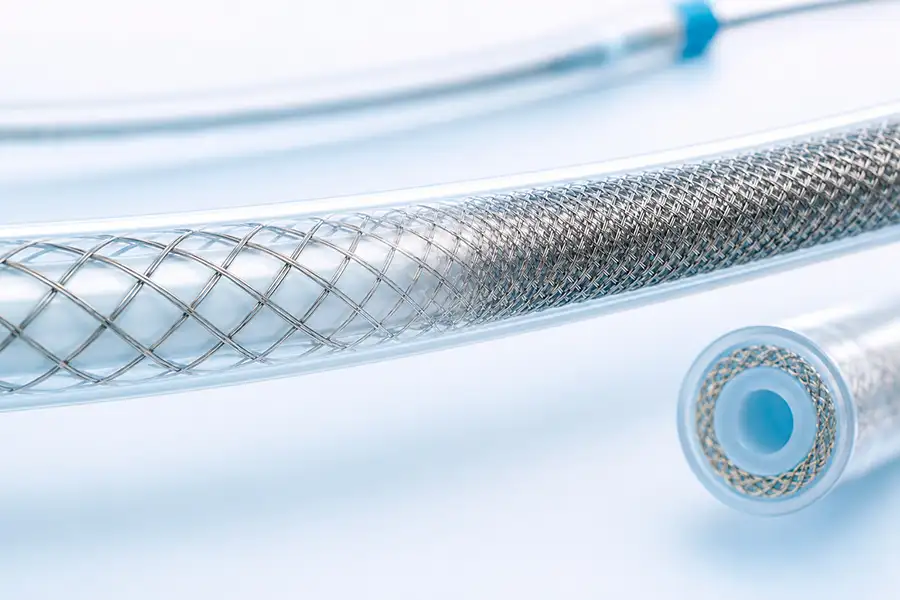
Braid density is quantified as Pics Per Inch (PPI) in standard braiding machine configurations, or sometimes Wraps Per Inch (WPI). Changing the PPI changes the angle at which the wires cross, radically altering the balance between column strength (pushability) and longitudinal bend (flexibility).
Understanding PPI: Low vs. High Density
PPI measures the number of wire crossovers along a linear inch of the catheter shaft.
- Low PPI (Long Pitch): The wires cross at a steeper, more axial angle. There is more open space between the braided wires, exposing more of the underlying polymer liner.
- High PPI (Short Pitch): The wires cross at a flatter, more perpendicular angle. The metal coverage over the liner is significantly higher, creating a tighter mesh.
The Mechanical Impact: Tuning the Shaft
Modifying your PPI allows engineers to intentionally “tune” specific zones of a catheter shaft. Here is how varying density impacts key performance metrics:
1. Pushability and Column Strength
- Low PPI delivers higher pushability. Because the wires run more parallel to the longitudinal axis of the catheter, they act like structural pillars. When a force is applied proximally, the energy translates efficiently down the shaft without axial compression.
- High PPI reduces pushability, as the tightly wound perpendicular wires can behave slightly like a spring, compressing under heavy axial loads.
2. Flexibility and Kink Resistance
- High PPI yields superior flexibility and kink resistance. The dense wire mesh prevents the polymer walls from collapsing inward or ovalizing when bent tightly.
- Low PPI results in a stiffer shaft longitudinally, making it more prone to kinking if forced through sharp anatomical bends.
3. Torque Transmission
- An intermediate-to-high PPI generally provides the most uniform, predictable 1:1 torque response. However, if the PPI is driven too high, the structural interaction can stiffen the shaft excessively, causing it to store energy and “whip” when turned.
Navigating the Trade-Offs: The Variable PPI Approach
Because clinical tracking demands a stiff proximal end for pushability and a soft distal end for non-traumatic navigation, a single static PPI across the entire catheter is rarely optimal.
Advanced braiding technology allows for variable PPI braiding on a single continuous mandrel. By continuously altering the pitch during the manufacturing process, a catheter can feature:
- A Low PPI proximal zone for maximum push and torque transmission out of the introduction site.
- A Graduated transition zone to prevent stress-concentration points.
- A High PPI distal zone for maximum flexibility and kink-free tracking through tortuous target vessels.
Summary Matrix for R&D Specifications
| Design Goal | Target PPI Configuration | Resulting Mechanical Shift |
| Maximize Push/Cross Force | Lower PPI (Axial bias) | Higher longitudinal stiffness, lower kink resistance |
| Maximize Tortuous Tracking | Higher PPI (Radial bias) | Lower column strength, superior kink resistance |
| Maximize Internal Pressure (Burst) | Higher PPI | Tighter mesh containment prevents polymer blowout |
Let’s Engineer Your Braid Profile
Specifying the ideal PPI requires balancing wire dimensions, polymer durometers, and wall thickness limits. Our manufacturing team utilizes precision programmable braiding equipment to develop custom variable-pitch prototypes tailored to your exact performance targets. Contact us to discuss your specs.