
When designing a minimally invasive catheter shaft, optimizing the balance between flexibility and structural integrity is a primary challenge. Unreinforced polymer tubing often lacks the mechanical properties necessary to navigate tortuous anatomy without kinking. To overcome this, engineers integrate metal or polymer reinforcement layers into the shaft using advanced medical braiding technology or continuous coiling.
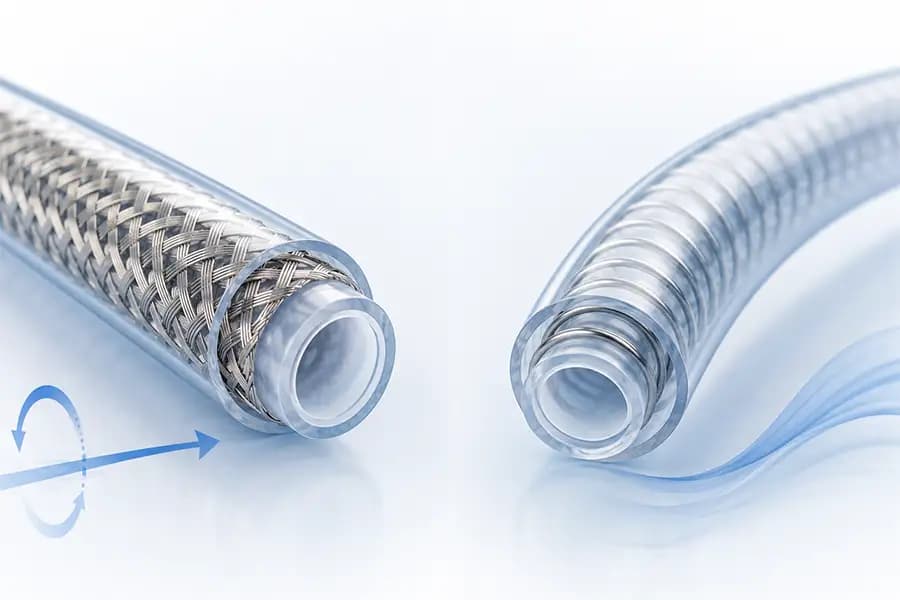
Braid Reinforcement: Maximizing Torque and Tensile Strength
Braid reinforcement involves weaving multiple wires (typically in a 1×1 or 2×2 diamond pattern) over an inner liner before encapsulating it with an outer polymer jacket.
Key Advantages:
- Superior Torque Transmission: Because the interwoven wires cross in opposing directions, a braided shaft excels at transmitting rotational force 1:1 from the proximal hub to the distal tip.
- High Tensile Strength: The braided matrix resists elongation under tension, making it ideal for devices that undergo high axial pull forces during deployment or retrieval.
- Excellent Pushability: Braids provide high column strength, allowing the catheter to be pushed through tight stenoses without buckling.
The Trade-Off:
Braided structures can struggle with extreme bend radii. Under severe deflection, the diamond lattice can compress, leading to ovalization or a sudden kink.
Coil Reinforcement: Unmatched Kink Resistance and Flexibility
Coil reinforcement utilizes a single or multi-filar wire wound helically around the inner liner, resembling a continuous spring.
Key Advantages:
- Maximum Kink Resistance: Coils maintain the cross-sectional roundness of the lumen even when bent around acute angles (such as the aortic arch or neurovascular bifurcations). The individual turns distribute bending stresses evenly.
- High Radial Strength: Coils provide excellent resistance against external crushing forces and internal pressures (such as balloon inflation), preventing lumen collapse.
- Unhindered Flexibility: Because the wire wraps continuously in one direction without interlocking, the shaft retains optimal lateral flexibility.
The Trade-Off:
Coils are notoriously poor at transmitting torque. Twisting a coiled shaft in the direction of the wind can cause the coil to tighten or expand, leading to a phenomenon known as “whip” rather than smooth, predictable rotation.
Direct Mechanical Comparison
| Performance Metric | Braid Reinforcement | Coil Reinforcement |
| Torque Response (1:1) | Excellent | Poor (Prone to whipping) |
| Kink Resistance | Moderate | Excellent |
| Column Strength (Push) | High | Moderate (May compress axially) |
| Radial/Crush Strength | Moderate | High |
| Lumen Ovalization Resistance | Moderate | High |
When To Choose Which
- Specify a Braid If: Your device requires precise steering, directional tracking, and high column strength to cross tough lesions (e.g., steerable guide catheters, electrophysiology shafts, CTO catheters).
- Specify a Coil If: Your device must traverse hyper-tortuous paths where maintaining an open inner lumen is critical, or where the catheter acts as a highly flexible conduit (e.g., neurovascular microcatheters, thrombectomy aspiration catheters).
- The Hybrid Solution: For the most demanding applications, engineers frequently design braid-over-coil or segmented shafts—utilizing a braid proximally for push and torque, transitioning to a coil distally for extreme flexibility and kink resistance.
Optimize Your Reinforcement Strategy Early
Choosing between a braid and a coil shapes your entire downstream manufacturing process, including laser-welding, tipping, and jacket reflow. Contact our engineering team today to review your torque and bend requirements and determine the optimal reinforcement configuration for your catheter.